
What If the Officer Isn't the Problem?
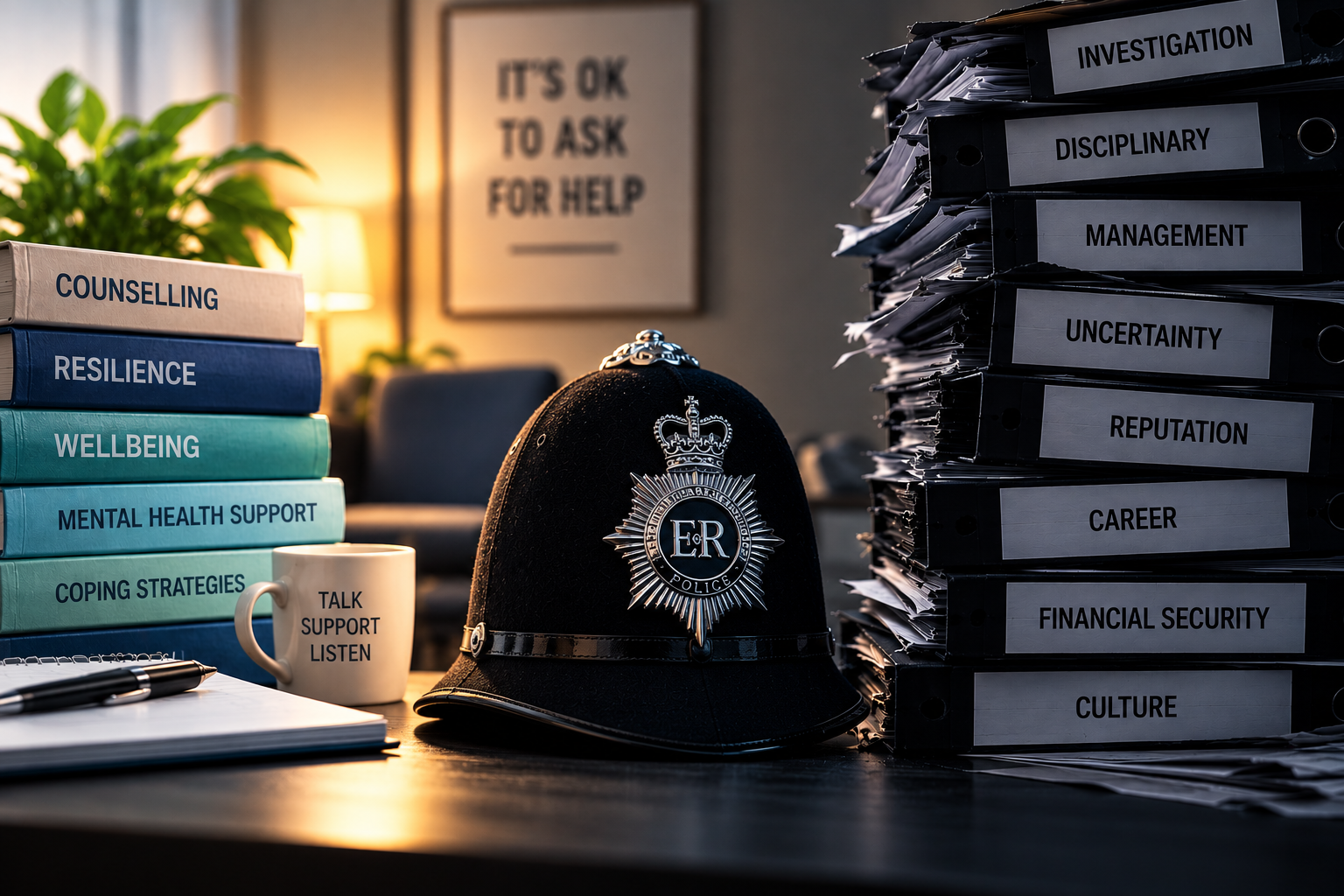
When a police officer becomes mentally unwell, much of the support offered is understandably directed towards that individual. They may be encouraged to seek counselling, improve their resilience, speak openly about how they are feeling or access psychological treatment. Research by former police officer and social scientist Mark Brain raises a more difficult question: what happens when part of the problem sits within the organisation rather than the individual?
There has been significant progress in the way policing talks about mental health. Conversations that might once have been avoided are increasingly taking place, officers are encouraged to seek help, and forces have introduced a range of wellbeing initiatives designed to support those experiencing difficulties.
Much of this work is valuable, but Mark Brain's doctoral research at Cardiff University suggests there may be a weakness in an approach that concentrates predominantly on the individual officer.
After interviewing 86 serving and retired police officers, Mark concluded that organisational relationships had negatively affected participants' mental health more than the episodic traumatic incidents they encountered operationally. His analysis identified four prominent areas: organisational control, internal Professional Standards investigations, organisational masculinity, and the experience of disconnecting or becoming disconnected from policing.
This creates an important distinction between helping an officer manage their mental health and examining what may be contributing to their poor mental health in the first place.
Consider an officer who has been under internal investigation for a prolonged period. They may be experiencing anxiety, sleeping badly, withdrawing from colleagues and worrying constantly about their career and financial future. Counselling might help them understand and manage those feelings, while occupational health may provide additional support. Neither intervention, however, can bring an unnecessarily delayed investigation to a conclusion or remove the uncertainty surrounding their future.
The same principle could apply elsewhere. Resilience training cannot reduce an excessive workload, therapy cannot change a workplace culture in which somebody feels unable to admit they are struggling, and encouraging an officer to talk about their mental health will have limited effect if they believe doing so could alter how they are viewed by colleagues or managers.
Mark acknowledges that counselling and cognitive therapies can be helpful. His criticism is not directed at those interventions themselves, but at the possibility that they become reactive when organisational causes are not also addressed. His thesis argues that focusing too heavily on trauma and individual cognition can place responsibility for poor mental health on the officer while failing to recognise the effect organisational relationships may be having upon them.
This matters because the language used around police wellbeing can sometimes imply that the solution lies primarily in changing the person. Officers are encouraged to become more resilient, recognise warning signs, develop coping strategies and ask for help earlier. Those are reasonable aims, but they should sit alongside an equally serious willingness to examine the environment in which officers are being asked to operate.
There is a danger otherwise that somebody struggling within a harmful situation can come to believe that their inability to cope with it represents a personal failure. An officer may look around and see colleagues apparently managing, while privately wondering why they cannot do the same. If the organisational circumstances are never examined, the question can become "what is wrong with this officer?" when a more useful question might sometimes be "what has been happening to this officer?"
That distinction does not remove individual responsibility. Police officers remain responsible for their conduct, managers will sometimes need to make difficult decisions, and organisations cannot eliminate every source of stress from a profession as demanding as policing. Mental ill-health can also arise from many different factors, including circumstances entirely unrelated to work.
Mark's research does not claim otherwise. His study was principally based on one anonymised case-study force, Sandford Police, and was designed to explore possible causal mechanisms rather than establish that the same experiences exist throughout every constabulary.
What the research challenges is the assumption that poor police mental health should primarily be understood as something happening within the individual.
If organisational relationships can contribute to an officer becoming unwell, then responsibility for improving police mental health cannot rest solely with the officer who is struggling. Forces should continue providing counselling, treatment, peer support and opportunities for officers to speak openly, but those measures need to be accompanied by scrutiny of workload, management, organisational culture, internal investigations and the way officers are treated when they become vulnerable.
A genuinely effective police wellbeing strategy should therefore be capable of doing two things at once: supporting the person who is struggling and being prepared to examine whether something within the organisation needs to change.